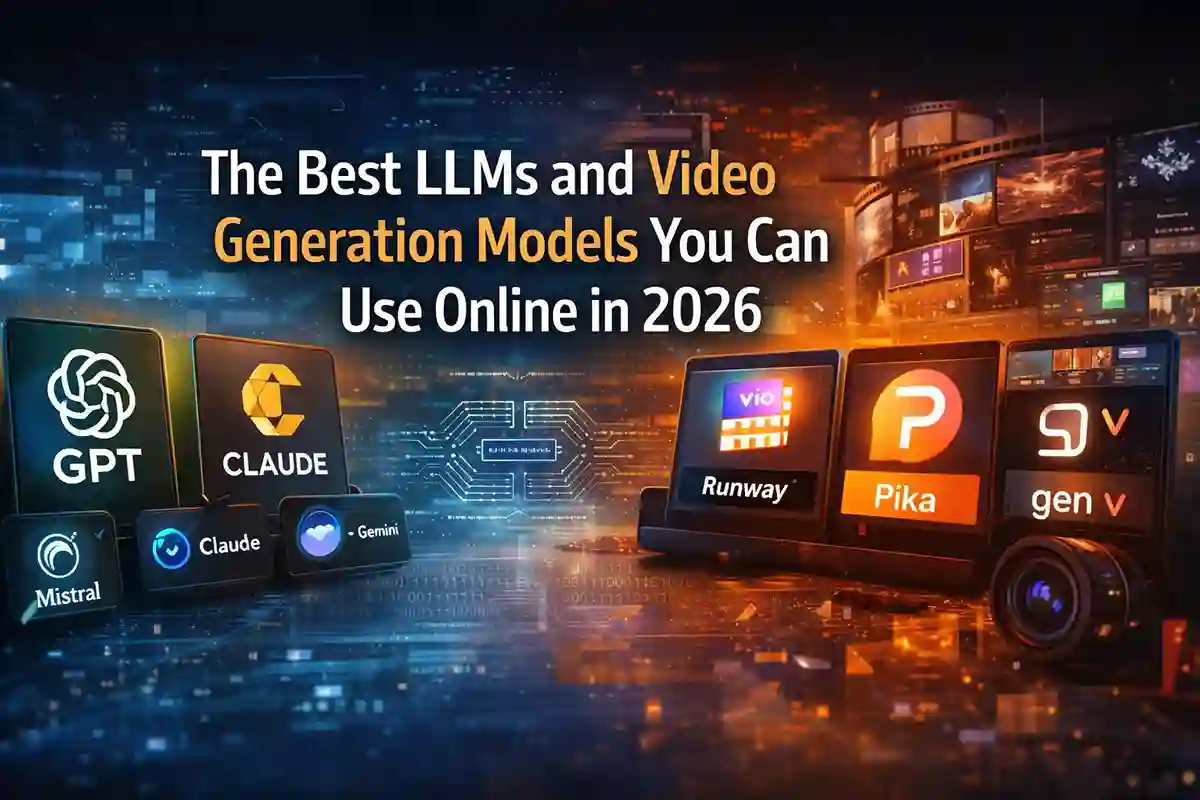
The Best LLMs and Video Generation Models You Can Use Online in 2026
A year ago, “best model” conversations were mostly about who could answer questions most accurately. Today, that question is too small. The modern buyer is choosing a model the way a studio chooses a camera system or a company chooses a cloud provider. You care about reasoning, speed, multimodality, safety, tool use, cost, latency, context length, and whether the model fits your workflow. You also care about availability, because a brilliant model that is hard to access is not much use when deadlines are real.
This article maps the major, widely used large language models and the leading video generation models available online, then matches them to practical use cases. You will see the tradeoffs clearly, so you can pick quickly without chasing hype. So here are the best LLMs and video generation models you can use online in 2026.
What Best Really Means in 2026
The biggest mistake people make when choosing an LLM is treating it like a single score. In practice, “best” depends on what you are optimizing.
If you write reports, you want structured thinking, citation friendliness, and consistency. If you code, you want a tool that uses strong debugging and low hallucination under pressure. If you build support automation, you want speed, low cost, and guardrails. If you build multilingual products, you want strong cross-language performance and a stable tone. If you work with documents, you want a long context that does not drift.
Video models follow a similar reality. Some are best for cinematic realism, some for fast social content, some for brand-safe commercial workflows, and some for creators who need aggressive stylization. The right choice is the model that reliably produces your target outcome with the fewest reruns.
Learn more: How to Install DeepSeek on Windows (Step by Step)
The Current LLM Landscape: Who the Major Players Are
The frontier LLM market is now shaped by a handful of dominant vendors and a rapidly improving open-source and open-weight ecosystem.
OpenAI’s GPT family remains a default choice for many teams, especially after the GPT 4.1 line emphasized coding, instruction-following, and very long context.
Anthropic’s Claude line is widely used for writing quality, reasoning, and agent style workflows, with Claude 4 positioning Opus and Sonnet as strong options for complex tasks, especially coding and long-running work.
Google’s Gemini family is deeply integrated into Google’s developer stack and products, and has pushed hard on multimodal, tool use, and agentic workflows, with Gemini 2.0 introduced as a model line designed for an “agentic era.”
Meta’s Llama models continue to anchor much of the open ecosystem, with Llama 3.1 called out by Meta as a major capability step and supported broadly through popular hosting and tooling.
Then you have high-impact challengers and enterprise-focused providers, including Mistral, Cohere, xAI, Alibaba’s Qwen family, and fast-rising Chinese and open community model lines that increasingly win on efficiency and deployment flexibility. Industry benchmarking and “arena”- style comparisons have also become a mainstream way to sanity-check which model is currently performing best on real prompts, not just lab tests.
Best LLMs Online, Strengths, and Ideal Uses
| Model family (major examples) | Where it tends to excel | Best fit use cases | Typical limitations to plan around |
| OpenAI GPT (GPT 4.1, GPT 4o, plus smaller variants) | Strong instruction following, strong coding, long context options, broad ecosystem | Cost can rise with heavy usage, policy constraints for some content, and output style can be “too polished” unless guided | Fast-moving model lineup can be confusing; behavior varies across tiers |
| Anthropic Claude (Claude 3.5, Claude 4 Sonnet and Opus) | Editorial writing, analysis, complex multi-step reasoning, software planning, and code reviews | Writing quality, reasoning, long task endurance, and agent workflows | Open ecosystem, self-hosting options, fine tuning flexibility |
| Google Gemini (Gemini 2.0 and newer model tiers in API) | Multimodal, tool use, integration with Google ecosystem, agentic workflows | Teams already on Google Cloud, multimodal apps, enterprise integration, search adjacent workflows | Availability and rate limits vary by plan, and sometimes, more conservative refusals |
| Meta Llama (Llama 3.1 and newer) | Private deployments, cost-controlled production, on premise needs, customization | Requires more engineering to match “managed API” convenience; quality depends on hosting and tuning | Speed, efficiency, and strong European enterprise adoption |
| Mistral (Mistral Large and smaller) | Latency-sensitive apps, multilingual European use, and private enterprise setups | Corporate knowledge assistants search over internal documents | Model choice depends on region and hosting, sometimes less strong on nuanced writing than top proprietary models |
| Cohere (Command family) | Retrieval augmented generation, enterprise workflows | Less famous in consumer circles, best results often require a good retrieval setup | Real-time conversation feel, social media adjacent analysis |
| xAI Grok | Tone can drift, depends heavily on prompt discipline, and uses case boundaries | Trend watching, conversational summarization, “hot takes” with guardrails | Tone can drift, depends heavily on prompt discipline and use case boundaries |
This table does not claim that only these models matter. It reflects the practical reality that most production teams first choose among these families, then narrow based on pricing, latency, compliance, and integration.
Best LLM for coding and software delivery
If your definition of success is fewer bugs, faster merges, and less time spent arguing with a model, you want three things: precise instruction following, strong debugging, and the ability to handle large code context without losing the plot. OpenAI’s GPT 4.1 series was explicitly positioned around major improvements in coding and instruction-following, with long context emphasized in the coverage and release notes. Claude 4 also frames Opus as a top-tier coding model and emphasizes sustained performance on long-running tasks, which matters when you are doing multi-hour agent-style work rather than single-shot snippets.
In practice, teams often keep both. One becomes the “architect and reviewer,” the other becomes the “implementer and debugger,” then you standardize your prompts and testing harness so you are not debating taste.
Read more: How to Write Effective AI Prompts for Adobe Firefly
Best LLM for long-form writing, blogging, and editorial quality
For long-form writing, the differentiator is less about raw intelligence and more about voice control, coherence across sections, and the ability to maintain a neutral tone without sounding like a press release. Claude 3.5 Sonnet was marketed as raising the bar for intelligence while keeping speed and cost advantages of a mid-tier model, and many writers prefer its “less corporate” default voice. GPT models remain excellent for structure, outlines, and clean sections, especially when you provide a strict style guide like you did earlier.
If your goal is to rank on search, consistency matters. Pick one primary writing model, lock a reusable “house style” prompt, then only switch models when you are prepared to recalibrate tone.
Best LLM for research, synthesis, and policy or market analysis
Here, the key is reasoning discipline, sensitivity to uncertainty, and how well the model respects boundaries such as “do not invent citations.” Claude and GPT are both strong, but you should choose based on your workflow. If you regularly feed large documents, context handling and stability become decisive. GPT 4.1’s long context positioning is relevant here. If you need agentic workflows, Gemini 2.0 was introduced specifically with tool use and agentic experiences in mind.
Best LLM for enterprise assistants that search internal documents
The model matters, but retrieval matters more. Cohere has positioned its models strongly in enterprise RAG-style setups, while Google’s Gemini lineup tightly integrates with Google Cloud and Vertex workflows. Llama remains a common choice for organizations that require self-hosting or strict data control.
The Video Generation Model Market Has Matured Fast
Stock image suggestion 2 (section divider): “film set camera with LED wall” or “editor at workstation color grading.”
Search keywords: “film production LED wall”, “video editor workstation”, “cinematic lighting studio.”
Video generation is now a real product category, not a novelty. The top models increasingly differentiate on four axes: visual realism, motion quality, character consistency, creative control, and commercial safety.
OpenAI pushed the category into mainstream awareness with Sora and later released Sora 2 as a flagship video and audio generation model. Google’s Veo line has moved quickly, with Veo 3.1 highlighted in recent updates and rolling into products like Gemini and YouTube-oriented workflows, as well as support for vertical formats that matter for social. Runway continues to compete aggressively, with Gen 3 Alpha marking a big quality step and Gen 4.5 positioned as a frontier model with strong motion quality and prompt adherence.
Meanwhile, Adobe’s Firefly Video Model targets a very specific buyer: teams who need a “commercially safe” content pipeline and tight integration with creative workflows. Luma’s Dream Machine and Ray3 line target creators who want strong physics, cinematic motion, and creator-friendly iteration tools. Kling has emerged as a major player, backed by Kuaishou, with public communication around its evolution into the 2.0 era. Stability AI’s Stable Video Diffusion remains a key reference point for open research and developer experimentation. Pika continues to sit in the creator tool layer, especially for expressive, fast iterations and socially friendly outputs.
The Best Video Generation Models Online and What They Are For
| Video model | Where it tends to excel | Cinematic clips, realistic scenes, high-impact brand storytelling | Watch outs |
| OpenAI Sora, Sora 2 | High realism, strong “world understanding” style motion, flagship quality positioning | Access can vary by region and plan, compute-intensive workflows | Social video pipelines, fast creative ideation, and teams in the the Google ecosystem |
| Google Veo 3.1 | Strong product integration, vertical support, workflow tools (Flow, Gemini) | Output length constraints and tiering differ by product, and quality depends on mode | Creator studios, previsualization, and marketing teams that iterate a lot |
| Runway Gen 3 Alpha, Gen 4.5 | Strong motion quality, prompt adherence, “creative control” emphasis | Agencies, brands, and enterprises that require IP risk control | Learning curve, cost management for heavy generation |
| Adobe Firefly Video Model | Commercial safety messaging, pro creative workflow integration | Creator-friendly, cinematic look, Ray3 emphasizes reasoning and HDR | Creative flexibility can feel constrained compared to wilder tools |
| Luma Dream Machine, Ray3 | Social creators, effects, character-focused clips | Narrative clips, mood boards, director style iterations | Output varies by prompt discipline; some features are tied to platform plans |
| Kling (Kuaishou) | Strong consumer creator adoption, rapid product evolution | Meme and social video, quick transformations, audio-synced expressions | Documentation and feature availability can differ by region |
| Pika | Fast creator workflow, expressive animation style options | Requires more setup, shorter clips, and quality depends on engineering | Less consistent for long cinematic continuity than top frontier models |
| Stable Video Diffusion (Stability AI) | Open research and developer experimentation | Prototyping, custom pipelines, local workflows | Requires more setup, shorter clips, quality depends on engineering |
Best for cinematic realism and “film-like” shots
If you want the strongest perception of realism and coherent motion, you start with Sora 2, Runway Gen 4.5, and Luma Ray3, then pick based on workflow. Sora 2 is positioned as a flagship model for video and audio generation. Runway’s Gen 4.5 is explicitly positioned as a frontier model with strong motion quality and prompt adherence. Luma’s Ray3 emphasizes reasoning and HDR output, which can matter for pro workflows and grading pipelines.
Best for social content at scale
For teams optimizing for vertical formats, speed, and integration with existing publishing workflows, Google’s Veo 3.1 and its Flow pipeline are hard to ignore, especially with vertical support and deployment across Gemini and YouTube-adjacent tooling. Kling and Pika also play well here, particularly for creators who value fast iteration and stylized results.
Best for brand-safe commercial and enterprise workflows
Adobe Firefly’s positioning is clear: a commercially oriented tool designed for professional use cases, such as b-roll creation and controlled generation within established creative workflows. If you work with regulated brands or conservative legal review, this category can matter more than pure quality.
Best for developers and custom pipelines
If you want model control, licensing flexibility, or local experimentation, Stable Video Diffusion remains a key option, especially as a base for developer-oriented pipelines. The tradeoff is that you often need more engineering effort to approach the polish of closed, fully managed systems.
Quick “Best For” Recommendations, LLMs, and Video Together
| Purpose | Best LLM choices | Runway or Luma for editorial B-roll style clips |
| Tech blogging, deep explainers, thought leadership | Claude (writing tone), GPT (structure and editing) | Runway or Luma for editorial B roll style clips |
| Coding, debugging, code review | GPT 4.1, Claude 4 | Runway for UI demos and explainer visuals |
| Enterprise knowledge assistant | High-end marketing, cinematic ads | Adobe Firefly for controlled brand usage |
| Social media content factory | Gemini, GPT smaller tiers for cost | Veo 3.1, Kling, Pika |
| High end marketing, cinematic ads | GPT plus human art direction | Sora 2, Runway Gen 4.5, Ray3 |
| Research and synthesis across long documents | GPT 4.1 long context, Gemini workflows | Usually not needed, use video only for summaries and storytelling |
A Practical Selection Strategy That Saves Time and Money
If you are building a content operation, including your blog plus possible video companions, you will get better results by standardizing around a small set of tools.
Pick one primary LLM for writing, and one secondary LLM for editing and fact discipline. The primary model sets voice and flow. The secondary model checks structure, contradictions, and clarity. This reduces the “model roulette” effect, where every article sounds different.
For video, pick one tool that matches your publishing channel. If your growth depends on YouTube Shorts, vertical-first matters, and Veo’s vertical support and workflow integration are directly relevant. If you are doing cinematic explainers or brand campaigns, Runway Gen 4.5 or Sora 2 are more aligned with that goal. If your brand is risk-sensitive, Firefly’s commercial positioning may be worth the creative constraints.
Conclusion
The market has reached a point where you can get excellent outcomes from several competing LLMs and video models, as long as you match the tool to the job. GPT 4.1 and Claude 4 stand out as go-to options for coding and complex writing workflows, with Gemini offering powerful integration and agent-oriented tooling for teams living in Google’s ecosystem. On the video side, Sora 2, Veo 3.1, Runway Gen 4.5, Luma’s Dream Machine, and Ray3, Kling, Pika, and Stable Video Diffusion collectively cover most real-world needs from cinematic storytelling to social content to developer experimentation.