Why Big Tech Is Building its Own Power Plants to Feed AI Data Centers
For most of the internet era, electricity was someone else’s problem. Technology companies focused on software, services, and silicon, while utilities quietly ensured that power flowed when servers were switched on. Data centers were energy-hungry, but they fit within existing grids. Power was a line item on an operating budget, not a strategic concern discussed in boardrooms. That separation is now breaking down.
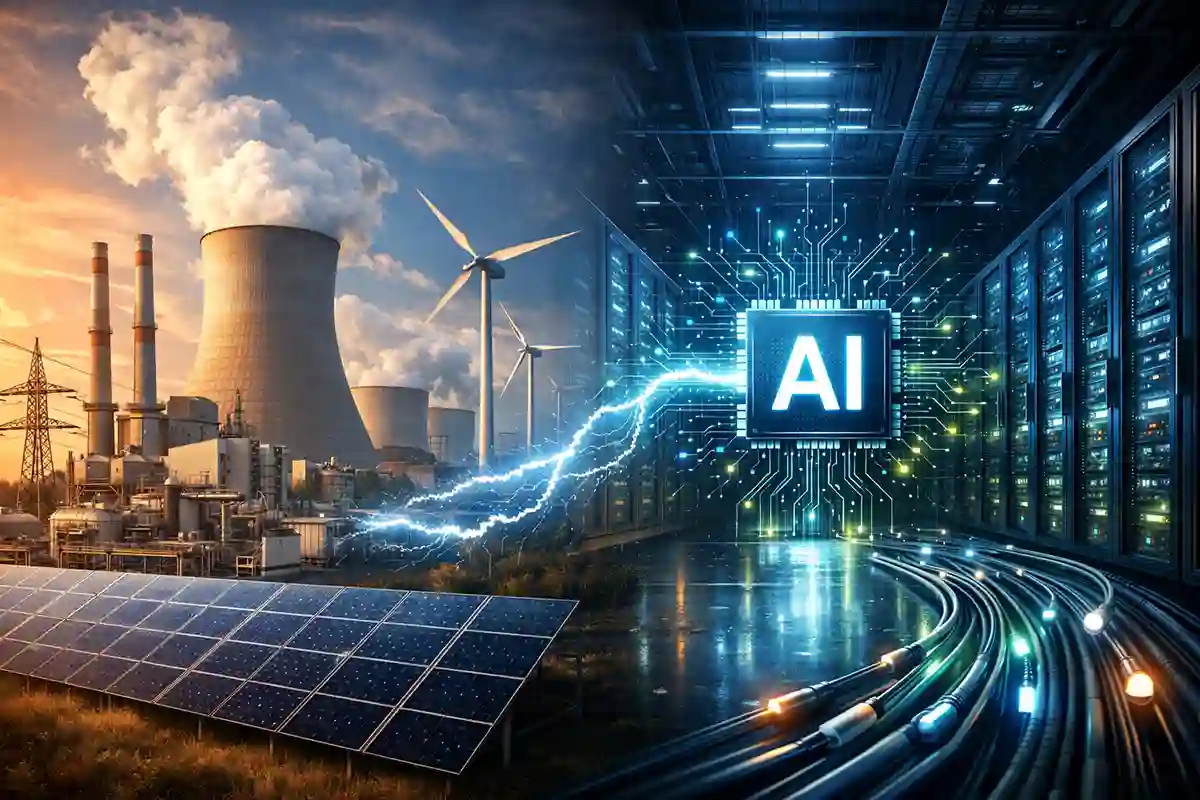
As artificial intelligence reshapes computing, it is also forcing a fundamental rethink of energy infrastructure. The world’s largest technology companies are no longer content to simply buy electricity from the grid. Increasingly, they are financing, co-developing, or directly owning power generation assets, ranging from massive solar farms and wind projects to small modular nuclear reactors.
This is not a public relations exercise or a sustainability branding move. It is a response to a hard physical reality: modern AI data centers are pushing power systems to their limits.
This article examines why big tech is building its own power plants to feed AI data centers. Why Big Tech is moving into energy production, how AI workloads have altered the economics of electricity, and what this shift means for governments, utilities, consumers, and the future of digital infrastructure worldwide.
From Server Rooms to Energy Giants
In the early days of cloud computing, data centers grew gradually. A new facility might consume tens of megawatts, a level that utilities could usually accommodate with modest upgrades. Even hyperscale cloud providers were largely dependent on regional grids and long-term power purchase agreements.
AI changed that equation almost overnight.
Training large language models, operating real-time inference services, and supporting generative AI products require enormous amounts of compute running continuously.
Unlike traditional web workloads, AI systems keep GPUs and accelerators operating near full capacity for extended periods. The result is data centers that demand hundreds of megawatts each, sometimes rivaling small cities in electricity consumption.
For grid operators, this kind of demand is disruptive. For technology companies, it is existential. Without guaranteed access to power, AI ambitions stall. As one cloud executive privately admitted, “Compute is useless without electrons.”
This realization has driven Big Tech into unfamiliar territory. Companies that once saw energy as a commodity now treat it as strategic infrastructure.
Why AI Data Centers Are Different
To understand why tech companies are building power plants rather than simply buying more electricity, it helps to understand how AI workloads differ from previous generations of computing.
Traditional enterprise data centers experienced fluctuating demand. Peaks and troughs allowed utilities to balance loads across the grid. AI data centers, by contrast, operate at consistently high utilization. Training runs can last weeks, inference services must be available around the clock, and downtime is not an option.
The quality of power matters too. Voltage instability, grid response latency, or supply interruptions can damage sensitive hardware and disrupt services used by millions. For AI providers offering global platforms, power reliability becomes part of their service-level commitments.
Just as importantly, AI growth is highly concentrated. A handful of companies are deploying clusters at unprecedented scale, often in regions not designed to handle such a load. Local grids can take years to upgrade, while AI competition moves in months.
Owning or controlling generation capacity offers a solution that the traditional grid cannot always provide quickly enough.
The Economics Behind Building Power Plants
At first glance, the idea of a software company financing a power plant seems extreme. In practice, it is a rational economic decision.
Electricity prices are rising globally, driven by fuel volatility, infrastructure constraints, and policy shifts. AI data centers magnify these costs. Even small increases in power prices can translate into hundreds of millions of dollars in annual savings at scale.
By investing directly in generation, tech companies can lock in long-term energy costs, reduce exposure to price swings, and secure guaranteed capacity. In some cases, they can generate power more cheaply than buying it retail, especially when renewable projects are optimized for data center demand.
There is also a competitive dimension. Power availability is becoming a bottleneck for AI expansion. Companies that secure energy early gain an advantage over rivals still negotiating with utilities. In effect, power plants are becoming part of the AI arms race.
This is not unprecedented. Heavy industries such as aluminum smelting and steel production have long built dedicated power infrastructure. AI, it turns out, falls into the same category as energy-intensive activities.
A Shift in the Tech-Utility Relationship
Historically, utilities dictated the terms. Large customers could negotiate favorable rates, but they remained dependent on grid operators. Today, that balance is shifting.
Big Tech brings enormous capital, long-term planning horizons, and predictable demand. Utilities, facing the challenge of decarbonization and aging infrastructure, increasingly welcome partnerships that fund new generation. In some regions, technology companies are effectively becoming anchor customers around which new power projects are built.
In other cases, tech firms bypass utilities entirely. They develop on-site generation, private transmission lines, and energy storage systems that reduce reliance on public grids. These “behind-the-meter” solutions give companies greater control but also raise regulatory questions about fairness and grid stability.
The result is a more fragmented energy landscape, where private infrastructure coexists uneasily with public systems designed for shared access.
What Kinds of Power Plants Are Being Built
Despite headlines suggesting a return to coal or other high-emission sources, the reality is more nuanced. Most tech-driven energy projects focus on reliability, scalability, and long-term cost control rather than short-term gains.
| Power Source | Why Tech Companies Use It | Key Challenges |
| Solar and Wind | Low operating costs, sustainability goals, scalable deployment | Intermittency, land use, storage needs |
| Natural Gas | Reliable baseload power, fast deployment | Emissions, regulatory risk |
| Nuclear (SMRs) | High-density, stable output, low carbon | Cost, public perception, long timelines |
| Energy Storage | Grid balancing, peak shaving | Material costs, limited duration |
Renewables remain central, but they are rarely sufficient on their own. AI workloads do not pause when the sun sets or the wind drops. This has renewed interest in nuclear energy, particularly small modular reactors that can be co-located with data centers and scaled incrementally.
While many of these projects are still in planning stages, the direction is clear: Big Tech wants energy sources it can depend on for decades.
Environmental Promises and Practical Trade-Offs
Publicly, technology companies frame their energy investments as part of climate commitments. Many have pledged to operate on carbon-free energy and present power plants as evidence of leadership.
There is truth to this narrative. Without private investment, many renewable projects would not exist. Tech capital has accelerated deployment in regions where utilities lacked funding.
At the same time, the environmental calculus is complicated. AI data centers dramatically increase overall energy consumption. Even when powered by renewables, they compete with other users for clean electricity. In regions with limited generation, this can slow decarbonization in other regions.
Water usage is another concern. Power plants, especially nuclear and gas, require significant cooling. In water-stressed regions, data center clusters can exacerbate local shortages, raising questions about social responsibility.
The challenge is not whether Big Tech should invest in energy, but how those investments are integrated into broader sustainability strategies rather than optimized solely for corporate needs.
Global Implications Beyond Silicon Valley
This shift is not confined to North America. In Europe, strict grid regulations and high energy prices have pushed tech companies to seek direct renewable partnerships. In Asia, especially in rapidly digitizing economies, governments actively court data center investments tied to new power infrastructure.
Emerging markets face a more complex situation. On one hand, tech-funded power projects can improve infrastructure and create jobs. On the other hand, prioritizing energy for AI data centers may divert resources from households and local industry.
For governments, the presence of a major AI facility backed by private power generation creates both opportunity and risk. It can accelerate modernization, but it can also entrench dependence on a small number of foreign corporations controlling critical infrastructure.
These dynamics are likely to shape digital sovereignty debates over the next decade.
How This Affects Consumers and Smaller Businesses
For most consumers, Big Tech building power plants feels distant. Yet the consequences eventually reach everyday life.
As large technology firms secure dedicated energy supplies, they insulate themselves from grid volatility. Smaller businesses and households do not have that luxury. Rising electricity prices may disproportionately affect those without bargaining power.
There is also an indirect cost. Investments flowing into private energy projects may reduce political pressure to upgrade public grids. Over time, this could widen the gap between well-funded corporate infrastructure and aging public systems.
At the same time, some benefits may trickle down. New renewable capacity and grid improvements funded by tech demand can increase overall supply, potentially stabilizing prices in the long run. The outcome depends heavily on regulatory frameworks and how inclusive energy planning becomes.
Power as the New Bottleneck of the AI Era
For years, discussions about AI focused on algorithms, data, and talent. Increasingly, power is the limiting factor. Chips can be designed, models can be trained, but without electricity, nothing runs.
This reality explains why energy strategy has moved from the periphery to the core of Big Tech decision-making. Building power plants is not a sign of excess ambition; it is a pragmatic response to physical constraints.
It also marks a broader shift in how digital infrastructure is understood. The cloud is no longer abstract. It is anchored in land, water, fuel, and long-term environmental impact.
Looking Ahead
The trend toward tech-owned or tech-backed power generation is unlikely to reverse. If anything, it will intensify as AI workloads grow and competition for energy tightens.
Over time, this may blur the line between technology companies and infrastructure providers. Firms once known for software interfaces may become some of the largest energy investors in the world.
The critical question is not whether Big Tech should build power plants, but how this power is governed, shared, and aligned with societal goals. Energy decisions made today will shape not only the future of AI but also the resilience and fairness of global digital infrastructure.
Understanding this shift matters because electricity, like memory or compute, has become a strategic resource. In the age of AI, whoever controls the power increasingly controls the pace and direction of technological progress.
Relevant Posts: